
Programs · Golf Fitness · Guide
Golf workout program: a simple weekly plan
A good golf workout program is two or three strength sessions a week, a short warm-up before you play, and a plan that changes with your season. Here is how to build one, with a sample week you can start with.
From the TPI-certified trainers at our golf fitness training studio in Los Altos.
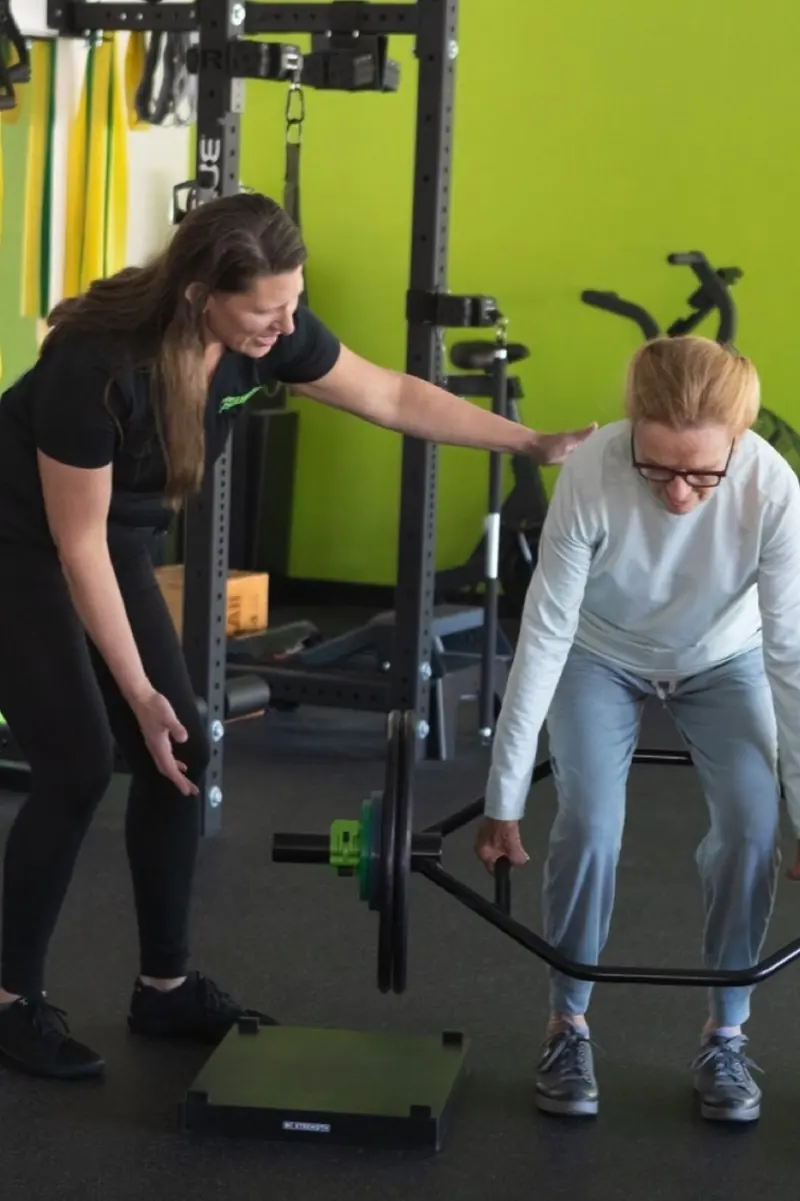
What a golf workout program should do
The golf swing asks a lot of your body in about a second. You rotate through your hips and upper back, brace on one leg, and send force from the ground up through the club. A golf workout program trains those pieces so the swing has more to work with.
Most good programs cover four things, roughly in this order:
- Mobility. Enough motion in the hips, upper back, and shoulders to turn without compensating.
- Stability and balance. Control on one leg and through the trunk, so you can hold your posture through the swing.
- Strength. Legs, glutes, back, and core strong enough to produce force and absorb it.
- Power. The ability to use that strength quickly, with throws, jumps, and fast rotation.
Notice what is not on the list: endless crunches, or machines that lock you into one plane. Golf is played standing up, rotating, so your training should be too.
A program also has to be something you can keep doing. A plan you follow for a year beats a perfect plan you drop in three weeks.
How many days a week should golfers work out?
Two or three days a week is the right range for most golfers. Two is enough to build strength and keep it. Three gives you room to add power work or extra mobility.
Count your golf in the week. If you play 18 holes on Saturday and practice on Wednesday, two lifting days, say Monday and Thursday, usually fits without leaving you stiff on the course. Avoid hard lower-body sessions the day before a round.
Sessions can be 40 to 60 minutes. If you only have 30, do the warm-up and the first three or four exercises well rather than rushing through all of them.
A sample weekly golf workout program
This is a starting template, not a prescription for your body. Pick weights that leave you two or three good reps in reserve on every set. Form comes first, load second.
Warm-up (both days, 8 to 10 minutes)
- 2 minutes of easy movement: brisk walking, a bike, or a rower
- Hip flexor lunge with a reach and rotation: 5 per side
- Thoracic open book on the floor: 8 per side
- Glute bridge: 10 reps, pausing at the top
- Bodyweight squat to a slow stand: 8 reps
Day 1: lower body and core
- Goblet squat or trap bar deadlift: 3 sets of 6 to 8
- Rear-foot elevated split squat: 3 sets of 8 per leg
- Single-leg Romanian deadlift: 2 sets of 8 per leg
- Band Pallof press: 3 sets of 10 per side
- Side plank: 3 holds of 20 to 30 seconds per side
Day 2: upper body, rotation, and power
- Half-kneeling cable or band row: 3 sets of 10 per side
- Dumbbell bench or push-up: 3 sets of 8 to 10
- Rotational medicine ball throw against a wall: 4 sets of 5 per side
- Lateral bound or skater hop, stick the landing: 3 sets of 5 per side
- Farmer's carry: 3 walks of 30 to 40 seconds
- Prone Y raise: 2 sets of 10
Optional Day 3: mobility and light conditioning
Repeat the warm-up, add a few extra minutes on the hip and upper back drills that feel tightest, and finish with a 20 to 30 minute walk. Walking the course instead of taking a cart counts too.
When every set feels easy, make one small change at a time: add a rep or two, then a little weight. Slow, steady progress is the point.
A 10-minute warm-up before you play
Many golfers walk from the car to the first tee and swing a driver cold. A short warm-up is the cheapest improvement in golf.
Do the same warm-up as above, then finish with:
- 10 slow, easy practice swings with a short club, building up
- 5 half-speed swings with your driver before the first tee shot
Kat Z., a former Division 1 golfer, put it this way after a year of training with Carl:
I now won't even golf without stretching and warming up for 20 minutes before!
Adjusting your golf workout program by season
Health sources such as Healthline describe golf training as seasonal, and that matches how we coach it. Your training should shift as your calendar does.
Off-season: build
This is the time for your heaviest, most demanding work. Two to three strength days, moderate reps, and plenty of mobility. If you want to add speed, this is when you build the base for it.
Pre-season: sharpen
Keep strength, but shift toward lower reps and add more power work: throws, jumps, and fast rotations. Cut volume slightly so you arrive fresh to the first rounds.
In-season: maintain
Two shorter sessions a week is enough. Keep the key lifts, drop the extras, and protect your legs on tournament weeks. The goal is to stay strong while golf is the main event.
If you play year-round, treat it as rolling blocks: about a month of building, a month of sharpening, then a lighter week, and repeat.
Can you do a golf workout program at home?
Yes. A pair of adjustable dumbbells or a kettlebell, a few resistance bands, and a wall for throws will cover most of the plan above. Swap the trap bar deadlift for a kettlebell deadlift, and the cable row for a band row.
A gym or studio makes it easier to load the big lifts heavier over time, which is where strength gains come from. But the best place to train is the one you will actually use.
Common mistakes in golf workouts
- Only stretching. Flexibility without strength leaves you with range you cannot control.
- Only core work. A strong trunk helps, but most swing force starts in the legs and hips.
- Training too hard before a round. Heavy legs on Friday can mean a sluggish Saturday.
- Copying a tour player's routine. Their training is built around their bodies, schedules, and coaches.
- Skipping progression. Doing the same weight for the same reps all year is maintenance, not training.
- Ignoring a limit. If one hip or shoulder does not move like the other, a generic plan will not fix it.
Is this program right for you?
It is a general plan for healthy adults. It is not medical advice, and it does not diagnose or treat anything. If you have an injury, a medical condition, or have been inactive for a long time, check with your doctor or physical therapist before you start. Good training works alongside them, not instead of them.
Golfers over 50 can use the same structure. Choose gentler versions of the jumps and throws, lean on the strength work and balance drills, and take more time to progress.
Junior golfers should train with a coach who understands growth and how much golf they already play. We cover that in our golf fitness program.
How we build golf workout programs in Los Altos
A plan from the internet is a good start. It cannot see how you move. At Calibrated, every golf client trains one-on-one in our Los Altos studio, with a trainer certified by the Titleist Performance Institute (TPI).
We begin with a TPI movement screen to find what limits your swing: a stiff upper back, a hip that will not rotate, or balance on one leg. Then we build a program around your game, your schedule, and your season, and progress it so you are challenged without overdoing it. You leave with a warm-up for the course and work you can do on your own.
Jason is TPI certified through Level 3 and certified in K-Vest golf movement analysis, and Carl, Creed, and Ruth on our team hold TPI certifications too. You can see everyone's credentials on the team page.
My driver speed is up to 115 max from 110 already. Also I'm finding I have fewer nagging injuries too!
I originally came to Jason for training to extend my years playing golf.
Golf workout program questions
How many days a week should I do a golf workout?
Two or three days a week works for most golfers. Plan them around your rounds, and avoid hard lower-body work the day before you play.
What exercises are best for golf?
Squats and deadlift variations, single-leg work, rows, anti-rotation core exercises like the Pallof press, and rotational throws. Add hip and upper back mobility drills to every session.
Will a golf workout program add distance?
It can. More strength and the ability to produce it quickly give you more to work with, and better mobility lets you use it. Results vary from person to person, and we do not promise a number.
Should I work out before or after golf?
Do a short warm-up before you play, and save the harder strength sessions for non-golf days or after a round. Lifting heavy right before you tee off will leave you tired.
Do I need a trainer, or can I follow a plan on my own?
You can start on your own with the plan above. A trainer helps when something is holding you back that a general plan cannot see, such as a hip that turns less than the other, or when you want your progress set up around your game.
Want a plan built around your swing?
Book a free consultation. We will talk through your game and goals, then recommend a plan that fits around your rounds. See more on our golf fitness training page, browse all programs, or contact us.