Programs · General Health · Guide
Strength training for women over 50: a practical guide
Strength training for women over 50 is two or three full-body sessions a week, built on a handful of basic movements, with weights that get gradually heavier. It is one of the best things you can do for your muscles, bones, balance, and independence, and it is never too late to start. Here is how.
From the private training team at our personal training studio for adults 50+ in Los Altos.
Why strength training matters more after 50
Everyone loses muscle with age, but the pace picks up in midlife. Stanford Lifestyle Medicine puts it at about 0.5 percent a year from around age 30, 1 to 2 percent a year at 50, and roughly 3 percent a year from 60.
For women, menopause adds a second shift. Falling estrogen speeds up bone loss in the years around and after the final period. Less muscle and less bone together are a big part of why everyday things, like getting up from the floor, carrying groceries, or catching your balance on a curb, can start to feel harder.
Strength training pushes back on both. It loads your muscles and bones in a way walking alone does not, and helps with balance, posture, and keeping up with what you love: hiking, travel, gardening, or the grandkids.
What the research says about bone and muscle
For years, women with low bone density were told to stick to light weights. Newer studies have challenged that.
In the LIFTMOR trial, 101 postmenopausal women with low bone mass were split into two groups. One did supervised, heavy strength and impact training twice a week, for 30 minutes, for eight months. The other did a light home program. The heavy-training group gained bone density at the lumbar spine (about 2.9 percent) while the light group lost some (about 1.2 percent). The researchers reported no adverse events under close supervision.
Note that the training was supervised and progressive: the women worked up to heavy loads over time rather than starting there.
The takeaway for most women is simple. Light, easy exercise is better than nothing, but your muscles and bones respond best to a real challenge, built up gradually. If you have osteoporosis or osteopenia, talk to your doctor about which exercises are right for you before lifting heavy.
How often should women over 50 lift weights?
Two or three days a week. The CDC guidelines for adults call for muscle-strengthening activity on at least two days a week, alongside 150 minutes of moderate activity such as brisk walking.
Two full-body sessions is enough to build strength and keep it. Three gives you more room to progress. Leave at least a day between sessions so your muscles can recover; Stanford suggests waiting 24 hours.
The best strength exercises for women over 50
You do not need dozens of exercises. You need a few movement patterns that match real life, done well and made harder over time.
- Squat. Sitting down and standing up. Start with a sit-to-stand from a chair, then a goblet squat holding a dumbbell or kettlebell.
- Hinge. Bending at the hips to pick something up. Start with a glute bridge, then a dumbbell or kettlebell Romanian deadlift.
- Push. Pushing a door or yourself up off the floor. Start with a wall or countertop push-up, then lower the angle over time, or use a dumbbell chest press.
- Pull. Pulling open a heavy door or lifting a bag into the car. Use a band row or a one-arm dumbbell row.
- Single leg. Stairs, curbs, and trails. Step-ups onto a low step, then split squats.
- Carry. Groceries, luggage, the laundry basket. Walk while holding a weight in each hand (a farmer's carry).
- Core. Bracing, not crunching. Dead bugs, side planks, and holding good posture during the carries.
Add a minute or two of balance practice to every session: standing on one leg near a counter, or walking heel to toe.
A sample beginner week
This is a starting template for healthy women who are new to lifting or coming back after time away. It is not a prescription for your body. Do Workout A and Workout B on two non-consecutive days, such as Monday and Thursday, and walk on most other days.
Warm-up (both days, 5 to 8 minutes)
- 3 minutes of easy movement: walking, a bike, or marching in place
- Arm circles and shoulder rolls: 10 each direction
- Glute bridge: 10 slow reps
- Bodyweight sit-to-stand from a chair: 8 reps
- Hold a counter and stand on one leg: 20 seconds per side
Workout A
- Goblet squat or sit-to-stand: 3 sets of 8 to 10
- Incline push-up (hands on a counter or bench): 3 sets of 8 to 10
- Band or dumbbell row: 3 sets of 10
- Step-up onto a low step: 2 sets of 8 per leg
- Dead bug: 2 sets of 6 per side
Workout B
- Dumbbell or kettlebell Romanian deadlift: 3 sets of 8 to 10
- Dumbbell chest press on a bench or the floor: 3 sets of 8 to 10
- One-arm dumbbell row: 3 sets of 10 per side
- Split squat, holding support if you need it: 2 sets of 6 to 8 per leg
- Farmer's carry: 3 walks of 30 seconds
- Side plank from the knees or feet: 2 holds of 15 to 30 seconds per side
Rest about a minute between sets. Move slowly on the way down and with purpose on the way up. Once you are confident with the movement, standing up a little faster out of the squat is a good habit: everyday life asks for quick strength, like catching yourself when you trip.
How heavy should you lift?
Heavier than most women expect. Pick a weight where the last two reps of each set are hard but your form stays clean. Stanford calls this leaving about two reps in reserve. If you could do ten more, it is too light. If your form breaks down, it is too heavy.
Many women start with weights that are too light and stay there for years. The goal is to work toward weights that feel challenging, safely.
How to progress
Change one thing at a time, and only when the current level feels solid:
- Add a rep or two to each set, with good control.
- Add a set.
- Add a little weight, then drop back to the lower rep number and build up again.
Can you build muscle after 50?
Yes. Muscle still responds to training in your 50s, 60s, and beyond. You may progress more slowly than you did at 25, and recovery may take a little longer, but strength often improves noticeably within the first weeks and months.
Protein helps. Stanford suggests 20 to 30 grams of protein at every meal for women who are strength training. If you have a medical condition that affects your diet, check with your doctor or a dietitian.
And no, lifting will not make you bulky. Building large muscles takes years of very specific training and eating. For most women over 50, strength training makes them look and feel firmer, more upright, and more capable.
Common mistakes to avoid
- Only doing cardio. Walking, swimming, and classes are great for your heart. They do not replace lifting.
- Lifting too light for too long. If every set feels easy, your body has no reason to adapt.
- Doing too much too soon. Jumping into a hard boot camp after years away is a common way to get sore, discouraged, or hurt.
- Skipping the legs and back. Arm toning with tiny weights is not where the biggest benefits are. Squats, hinges, and rows are.
- Pushing through sharp pain. Muscle effort is normal. Sharp or joint pain is a sign to stop and get advice.
Is this plan right for you?
It is a general plan for healthy adults. It is not medical advice, and it does not diagnose or treat anything. If you have osteoporosis, a heart condition, joint replacements, an injury, or have been inactive for a long time, check with your doctor or physical therapist before you start. Good training works alongside them, not instead of them.
You can do everything above at home with a sturdy chair, a resistance band, and a few dumbbells or a kettlebell. A coach helps when you are not sure your form is right, when you have an old injury to plan around, or when you want someone to decide when it is time to go heavier.
How we train women over 50 in Los Altos
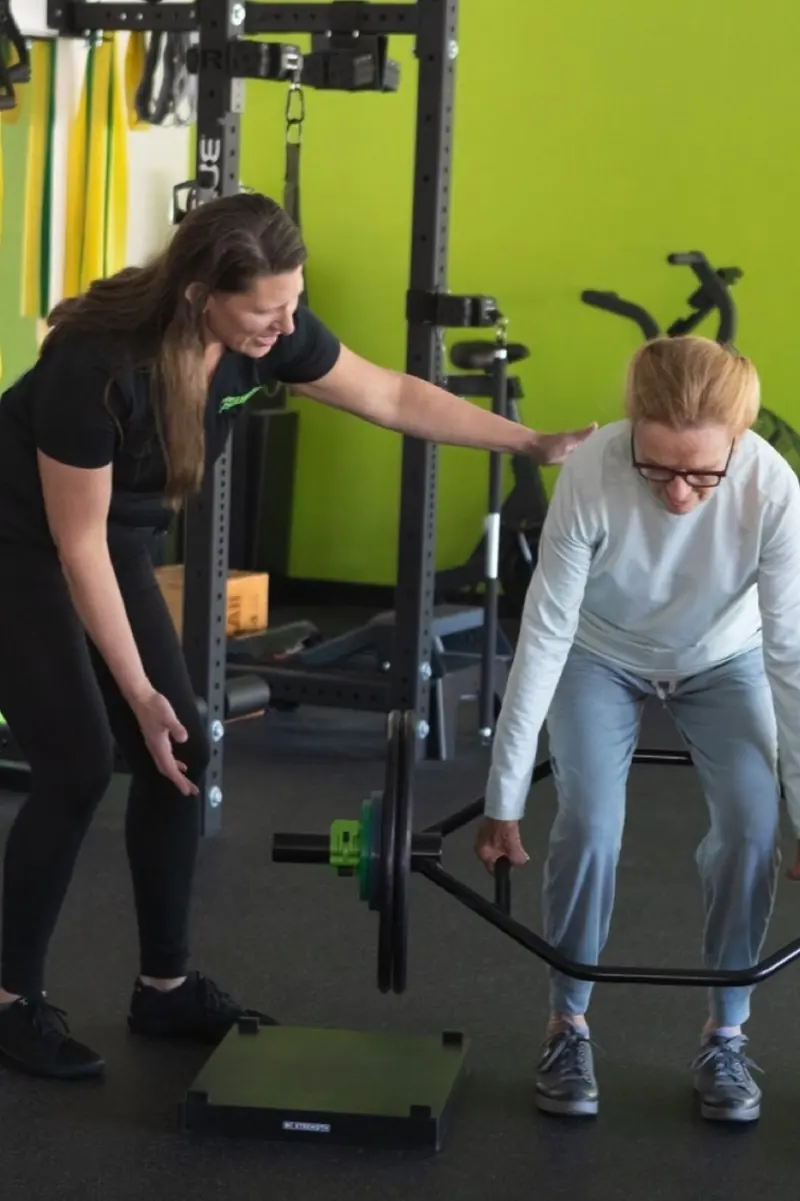
At Calibrated, every client trains one-on-one in our private Los Altos studio, with nobody else on the floor competing for your coach's attention. We start with a free consultation, then ask about your history and goals, see how you move, and start slow and safe.
From there we build strength, balance, and mobility at your pace, and progress the weights as you are ready. If you are working with a doctor or physical therapist, we are happy to work alongside them. Between sessions, you have a direct line to your coach.
Ruth on our team holds a Women Fitness Certification and a Longevity Certification, and Jason, Carl, and Ruth are all Russian Kettlebell certified. Sue offers private Pilates as a complement to strength work. You can see everyone's credentials on the team page.
Jason took my depleted, under nourished, weak body and turned me into a functional, stronger person with a ton of mobility. … and I'm over 60!
"Coach Ruth" urged me in August, 2022, to begin working out with her for 1-hour weekly at a scheduled time. To date, May, 2025, my regime has rejuvenated my body and its myriad parts and mysteries … Ruth Schreiner is a born trainer.
I truly thought I had waited too long & it wouldn't be possible to regain the strength I'd lost. … Long story short after 3 months I feel stronger & better than I have in years.
Strength training for women over 50: questions
Is it too late to start strength training at 50, 60, or older?
No. Muscle responds to training at any age. Start with simple movements at your level, like sit-to-stands and wall push-ups, and build from there.
How many days a week should women over 50 strength train?
Two or three days a week, with at least a day of rest between sessions. The CDC recommends muscle-strengthening activity on at least two days a week for adults.
How heavy should I lift?
Heavy enough that the last two reps of each set are hard but your form stays clean. As that gets easier, add reps, then sets, then a little weight.
Can strength training help with bone density after menopause?
Research suggests it can. In the LIFTMOR trial, postmenopausal women with low bone mass who did supervised, progressive heavy training twice a week gained spine bone density over eight months. If you have osteoporosis or osteopenia, ask your doctor which exercises are right for you.
Will lifting weights make me bulky?
No. For most women over 50, strength training builds firmer muscle, better posture, and more strength for daily life, not bulk.
Do I need a gym, or can I strength train at home?
You can start at home with a chair, a resistance band, and a few dumbbells or a kettlebell. A gym or studio makes it easier to keep adding weight over time.
Want a plan built around you?
Book a free consultation. We will talk through your goals and history, then recommend a plan that starts at the right level for you. See more on our personal training for adults 50+ page, browse all programs, or contact us.